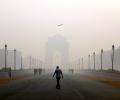
The problem is so severe that multiple agencies have issued several precautionary measures.

The increase in stubble burning has kicked off a political slugfest, with Union Environment Minister Bhupender Yadav on Wednesday saying that there had been a 19 per cent rise in farm fires over 2021 in Punjab and that the Aam Aadmi Party had turned the national capital into a gas chamber.

Interpol has issued a Blue Notice against the owners of a Goa nightclub who fled after a fire claimed 25 lives. Police are investigating violations and illegalities related to the nightclub's operation.

The city's 24-hour Air Quality Index, recorded at 4 pm every day, stood at 418, up from 334 the previous day, and it may trigger stringent restrictions under the third stage of the graded response action plan to mitigate hazardous conditions.

No improvement in the air quality in Delhi-NCR is expected for another three days, authorities said on Monday, as the Supreme Court directed the Centre to call an emergency meeting to decide on measures like stopping non-essential constructions, transport and power plants by Tuesday evening.
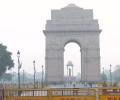
According to forecasting agencies, the city is set to record its best air quality for the day after Diwali since 2015 on Tuesday.

The Delhi Pollution Control Committee (DPCC) also issued guidelines for implementation of the ban on firecrackers, which included directions to the Delhi Police to register a first information report against the violators of the ban.

The overall Air Quality Index was recorded at 231 on Sunday which falls in 'poor' category.

Production, storage and sale of firecrackers in the capital will be punishable with a fine of up to Rs 5,000 and three years jail under Section 9B of the Explosives Act, the minister told a press conference in New Delhi.

There will be a blanket ban on the production, sale and use of all types of firecrackers in the national capital, including on Diwali, till January 1, 2023, Environment Minister Gopal Rai said on Wednesday.

During this Ramzan, another religious practice was turned into an offence: Breaking the fast, or iftar.

Pollution levels were inching towards 'severe plus emergency' category due to a change in wind direction and rampant stubble burning in neighbouring states

These hotels in south Delhi's Mahipalpur area are popular among tourists

The lion's share of the amount -- Rs 1,003 crore (till November 10) -- comes from an Environment Compensation Charge (ECC) imposed by the Supreme Court in 2015 on trucks entering Delhi while the rest is made up of cess on every litre of diesel sold, in effect since 2008.

Delhi Chief Minister Arvind Kejriwal announced that primary schools will be closed from Saturday in view of spike in pollution levels in the national capital.
Violation of the provisions entails a punishment of a jail term up to five years or with fine up to Rs 1 crore or with both, the ordinance released by the Ministry of Law and Justice on Thursday said.

Report by Greenpeace also presented a grim picture of India's pollution level.

The dense cover of grey haze shrouding Delhi for almost a week, reminiscent of the 1952 Great Smog in London, plunged the city's air quality to the season's worst.

The air quality is expected to improve further due to wind speed favourable for the dispersion of pollutants.

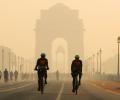
A blinding layer of dense fog over north India, including Delhi, caused major inconvenience to commuters. The visibility levels were 50 metres around 5:30 am.

Terming the incident as 'horrific', the Aam Aadmi Party hit out at the Centre by drawing a comparison with the Jallianwallah Bagh massacre, whose centenary is being observed on Saturday.

Air quality in the national capital deteriorated alarmingly a day after Diwali as pollution levels spiked more than five times higher than normal leaving many at the risk of respiratory problems.

The top court also asked the state governments of Punjab and Haryana to pursue the farmers for two weeks not to do stubble burning.
Govt has done away with the need to secure crucial permits.

The United States embassy's pollution monitor recorded 'hazardous' air quality with the index scoring an alarming 878, which the mission considers 'beyond its air quality index' (AQI), which ends at 500.

A bench of Justices Arun Mishra and Deepak Gupta also directed the Delhi government and the Central Pollution Control Board to place before it the data of pollution in Delhi from October till November 14 this year. The bench also directed them to submit pollution data from October 1 to December 31, 2018.

He alleged that the BJP made people burst firecrackers on Diwali.

Violation of the provisions entails a punishment of a jail term of up to five years or with fine up to Rs one crore or with both.
Violation of the ban will invite punitive action, including a fine or a jail term or both, detailed under Section 15 of the Environment Protection Act (EPA) and under bylaws of respective municipal corporations, they said. For effective enforcement of the ban, national and state-level control rooms have been set up and special enforcement teams formed to check illegal manufacture, import, stocking, distribution, sale and use of banned SUP items, officials in the ministry said.
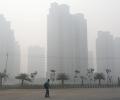
Air pollution may lead to a faster spread of Covid-19 infection as it causes coughing and sneezing, government officials told a parliamentary panel on Friday, according to sources.

Amid criticism over the formation of foam in the Yamuna -- a sign of its hazardous water quality -- the Delhi government on Tuesday deployed 15 boats to remove the froth with the help of ropes.

The dip in the air quality can be attributed to low wind speed and temperatures which allowed accumulation of pollutants.

Despite legal deterrent in place to discourage people from doing so, by dusk, residents in many neighborhoods, including some areas in south Delhi and northwest Delhi, had started bursting crackers.

As many as 753 violators of the odd-even scheme were challaned on Monday, the 11th day of the car-rationing measure's implementation in New Delhi.

The ban on certain single-use plastic (SUP) items kicks in from Friday, with state governments initiating an enforcement campaign to identify and close down units engaging in production, distribution, stocking and sale of such items, officials said. Though several manufacturers have said they are not prepared to implement the ban due to a lack of alternatives, Union Environment Minister Bhupender Yadav had on Tuesday said the government had given enough time to the industry and the general public to prepare for the ban on SUP items and it hopes for everyone's cooperation in implementing it from July 1. Violation of the ban will invite punitive action, including a fine or a jail term or both, detailed under Section 15 of the Environment Protection Act (EPA) and under bylaws of respective municipal corporations, officials in the Union environment ministry said.
The Supreme Court Wednesday directed the Centre and states to ensure implementation of the decisions taken in a meeting to curb air pollution, observing that it cannot get into the 'nitty gritty' and the bureaucracy has developed a 'sort of inertia' of not taking decisions which are left to the courts.

Officials have admitted that the problem of frothing will continue until sewage treatment plants in Delhi are upgraded to meet the new standards.
A bench of the NGT, headed by its chairperson Justice Adarsh Kumar Goel, directed that the order will also apply to all cities and towns in the country where the average of ambient air quality during November (as per available data of last year) falls under 'poor' or worse category.

Less than six months ago, Delhi was gasping for breath. Authorities said air quality had reached "unbearable levels". Schools were shut, flights were diverted, and people were asked to wear masks, avoid polluted areas and keep doors and windows closed. But during the lockdown that began on Mar 22, the concentration of poisonous PM2.5 particles in a cubic metre of air averaged at 44.18, according to a Reuters analysis of government data, indicating a rare "good" rating, the safest level on the scale.

Ahead of the Delhi assembly polls scheduled to be held early next year, state Congress chief Devender Yadav said on Friday that the party will contest on all 70 seats and there would be no alliance.
